Wednesday, 5 February 2014

The Story of the Village of Bell Ville, Córdoba, Argentina (Part 3 of 7)

The story so far:
My grandmother and mother were born in Bell Ville, originally named Fraile Muerto, and this series of posts is the result of my research into this village, later a town.  There were English farmers in the countryside and (mainly) Italian immigrants in the town, and I descend from both.
Part 1:  The history of the area up to the mid nineteenth century.
Part 2:  The arrival of the English farming pioneers as typified by Richard Seymour and Frank Goodricke, who resided at their farm Monte Molino from 1865-68;  their first encounter with marauding indians;  headman Lisada’s gesture of friendship to an indian scouting party.


Of Native Indians and Gauchos
For the moment Dick Seymour and Frank Goodricke realised that cattle-farming was the profitable way forward; the conditions were ideal.  The two English partners set about obtaining bullocks, but learned the hard way that it was only going to work if they were purchased a long way from Monte Molino.  There were plenty available locally, of course, but they soon found that no matter how carefully the animals were locked in at night, they had often managed to escape by the following morning and returned to their previous abode.  After one such occasion when they had to recover them across great distances on three consecutive mornings, they raised the height of the gates to 6 feet.  On the fourth morning after another wearying foray into the countryside, they realised that the only solution was to get one of their peons to sleep with them.  The creatures eventually settled down, but all the exercise had caused them to lose a lot of weight.

And of course there was the matter of the indian raids.  There was a pattern to them.  If they could get away with it they stole everything they could get their hands on at the farm – weapons, food, clothes – and were prepared to kill to do it.  However the main purpose was to steal livestock to take back to their people. 


Horses were greatly sought after, and cattle.  Sheep rustling however had not yet taken hold because the creatures didn’t move fast enough and shared the country’s custom of sleeping in the middle of the day, lying down on the ground and huddling stubbornly together for several hours in the early afternoon.  Seymour and Goodricke thus judged that investing in sheep would be a good idea.  Because of indian raids they had been unable to get the necessary shearing tools in time, so it was late in the season by the time they took their wool for sale, and made little out of it.

But there were other problems.  They were easy prey to the local grey foxes and the puma.  The puma is now only to be found in hilly areas or in the desolate parts of Patagonia, in those days it existed in plentiful numbers on the plains.  Seymour records in his book that they were forced to kill six in one year because a single puma could despatch 20 sheep in one night.  He reports that the largest they ever caught measured nine feet from nose to tail. 

The worse Indian raid they were to encounter was in late September 1866 when Seymour and Goodricke rode the 15 miles to a neighbouring farm by the name of Monte Llovedor (Rainy Grove) to see how their friends John Pearson and Thomas Edwardes were faring in setting up their farm.  At that point they had constructed a small fort surrounded by a ditch, and were shortly going to build a house.  Pearson was away on business, but Edwardes and his capataz Dan Mulligan, two English and two local peons greeted them cheerfully as they worked on the ditch.  After a pleasant few hours Seymour’s party left mid afternoon, taking Mulligan with them because Edwardes had agreed to buy one of the Monte Molino horses, and the headman was to bring it back to Monte Llovedor the following day.

The following morning one of the farmhands reported that the Indians were in the vicinity once again.  Mulligan decided to stay on for a couple more days at Monte Molino because he did not fancy his chances returning to Monte Llovedor with his horse and the other in tow.  The day after his departure all seemed quiet so Goodricke and Lisada set out to check whether there were any Indians in the neighbourhood, and to pick up any stray cattle they might have left behind.

Nine miles later they came upon traces of a large Indian encampment close to the river where they found strewn around a number of worthless items, evidently the property of English settlers because one of them was a book in English with Pearson’s name on the fly cover.  Now seriously concerned, they quickly headed back to Monte Molino to get reinforcements, fast horses and weapons.  With Seymour they headed for Monte Llovedor as quickly as possible. 

When they got there they saw with horror that the fort had been destroyed, and the only sound emanating from the site was a mournful howling of dogs.  Fire had consumed the area, there were charred remains of two carts with trunks broken open and all the contents which the Indians had not taken away such as letters and books, were scattered about in all directions.  In the ditch were the remains of three people – Edwardes and the two English farmhands.


Meanwhile Mulligan had got there several hours before them and had headed onwards to Fraile Muerto to report the incident to the authorities.  As Seymour and Goodricke stood at the ditch mourning the loss of their friends they heard the sound of horses galloping towards them.  To their profound relief it turned out to be Nazario Casas, the village’s Chief of Police with a ragtag troop of nervous and trigger happy militia – Seymour himself narrowly escaped injury when one of the militia discharged his rusty gun close to his head.

Later they heard the story from one of the farmhands who had been there.  The men were busy preparing their evening meal in their tent when they heard the sound of horsemen approaching at great speed.  They seized their arms and ran to the recently finished fort.  There were about 200 riders surrounding them, the leader of which gave them to understand through the gaucho interpreter that if they gave up everything their lives would be spared.  Edwardes told them they could take what they wanted from the tent, but that if they entered the fort they would be fired at. 

Unfortunately as they had only just been digging the ditch they had not yet disposed of the spoil, which was piled high on either side, and this the indians used to conceal themselves.  With their lances they punched holes in the mounds, stuffed them with dried grass and set fire to them.  Surrounded by fire and smoke, the besieged men eventually had to run for it, and were murdered one by one as they tried to get beyond the fire.  The peón telling the story was the only one spared because he had a wounded leg and had managed to hide in the ditch.  When discovered the gaucho interceded on his behalf with the Indians, because he knew him.  He eventually managed to limp his way to a neighbouring estancia and from there was taken to Fraile Muerto to get medical attention.


Monte Llovedor was abandoned, and Pearson himself struggled on for three years, eventually perishing of sunstroke in 1869.  It was a long time before new settlers came back to the area.

With these sorts of tragic stories it was small wonder that the Indian raid on an English farm at Monte de la Leña (Firewood Grove) merely caused amusement when it was later related in the village.  The indians had surprised the Europeans within while the latter were carrying out their ablutions and getting dressed early one cold morning and they had no option but to scramble onto the roof of their recently finished hut in various stages of undress, huddling together for warmth and watching helplessly while the marauders stole everything they could lay their hands on. 


It was now fifteen months since Dick Seymour had arrived at Monte Molino, and the railway had at last reached Fraile Muerto, thankfully making the stuffy, horse-drawn coaches a thing of the past.  The village now boasted a population of 1000 and many new houses had been built.  The Chief of Police had increased powers to keep law and order and had twelve enlisted men to command, in addition to volunteers when indian raids threatened.

It was a relief when that a bridge across the river had been built which gave access to the railway station, for up until that point getting goods home was a major exercise, taking up to three days to complete.  The raft was not large enough to carry carts, so everything had to be loaded and unloaded between the station and the raft, and after being ferried across, had again to be placed in carts to deliver to the fonda in the village, there to await their own transport. 

Seymour was an acute observer of the people around him, and noticed that the gauchos and locals had the refinement and self-controlled manners of their Spanish ancestors, yet not their morals and religious fervour – and judged that missionaries could well do some good work there. 

Traditional gaucho with his constant companion...

“The gauchos make a perfect jest of everything connected with religion, and are scarcely ever seen inside a church, appearing to think that the women can do all that is necessary for them. “
 
He had mixed feelings about the gaucho – so admired these days as the essence of the Argentine spirit.  His experience of them in the mid nineteenth century was that they were rugged loaners of unsociable and reclusive disposition; wedded to their horses, they never stayed anywhere for very long.  Indian tribes often had a gaucho in tow to act as interpreter with the farmers, and these individuals led particularly tough lives.

...in good times and bad (Molina Campos)

There were various interesting characters in the village which Seymour ably described. 

The rough and ready bar where a man could get a meal – the fonda - was run by an Italian known as Don Pepe with his partner Luigi...

Don Pepe had previously been a priest, choosing to renounce monastic life for a bit more excitement.  As he told Seymour, he was then able to give free rein to the swearing which had previously been denied him… that is until he had caught cholera a few years back.  He was so surprised and grateful to have survived that he vowed never to swear again.

One of the bilingual residents of the village considered himself to be a ‘gentleman’ of the highest order descended from one of the River Plate’s finest families.  He was considered local royalty, particularly in view of his fondness for the English language and Shakespeare, whose lengthy quotes held the locals in thrall.

Don Nazario Casas, the Chief of Police who had a militia of 12 soldiers and some volunteers, the totality of their defence against the Indians in the area, took his job very seriously, and on one occasion had one of the farmhands at Monte Molino put to death.  This man had deserted from the army, having murdered one of his officers and gone on the run, arriving at the farm looking for work, which was given him in ignorance of his past.  And there it would have remained, had the man not given in to the temptation of going to the village on payday.  Even then nothing would have happened if he had behaved himself, but a pattern was established each month, whereby he started drinking and gambling, the former affecting his behaviour with the latter, and he became known by all.  His luck ran out when an officer passing through Fraile Muerto recognised him, knew what he had done, and reported him.  He was arrested, tried and shot.

Seymour was greatly impressed by the Catholic priest, who was Italian.  He says  -

“…He was not a very clerical character, but pleasant and good-natured, and having been educated as a doctor did all he could for the bodies of his parishioners, and I trust also for their souls.  What curious vicissitudes of life had at length landed him in this secluded part of the Argentine Republic I do not know, but he was a well-informed man, acquainted with several modern languages and a very pleasant companion.  He came into the fonda at one time for his meals, while his house was building, and it was there I used to see him.  During the cholera time he exerted himself nobly for the people, and I hope may have made some lasting impression on them.  “
The village’s doctor was Don Bartolo, a clever little man, well-informed about general things and devoted to gardening.  He always welcomed the foreigners hospitably to his little house, where his pretty niece Doña Flores would serve them refreshments.  He had two club feet, so could only hobble around town.  When as a result he was unable to go to the rescue of a farmhand who had fallen on a fence while carrying a sheep on his pommel and broken his leg, Dick Seymour helped out and set the man’s thigh; he recovered well and earned praise from Don Bartolo.

Dick was impressed with the general health of the population, remarking that they rarely got ill, and when they did they healed quickly.  He calculated however that three people in five had at some point had smallpox in the past, but the epidemic had clearly been overcome.  Not so with cholera, which he witnessed during his years in Argentina.  He makes one other comment –

“…The only peculiarity which I am quite unable to account for is that in spite of the large amount of fresh pure air, they find any cuts or wounds very difficult to cure, and lockjaw will come on from the most trifling accident.“
Unbeknown to him this was tetanus, for which a vaccine was not developed till 1924.
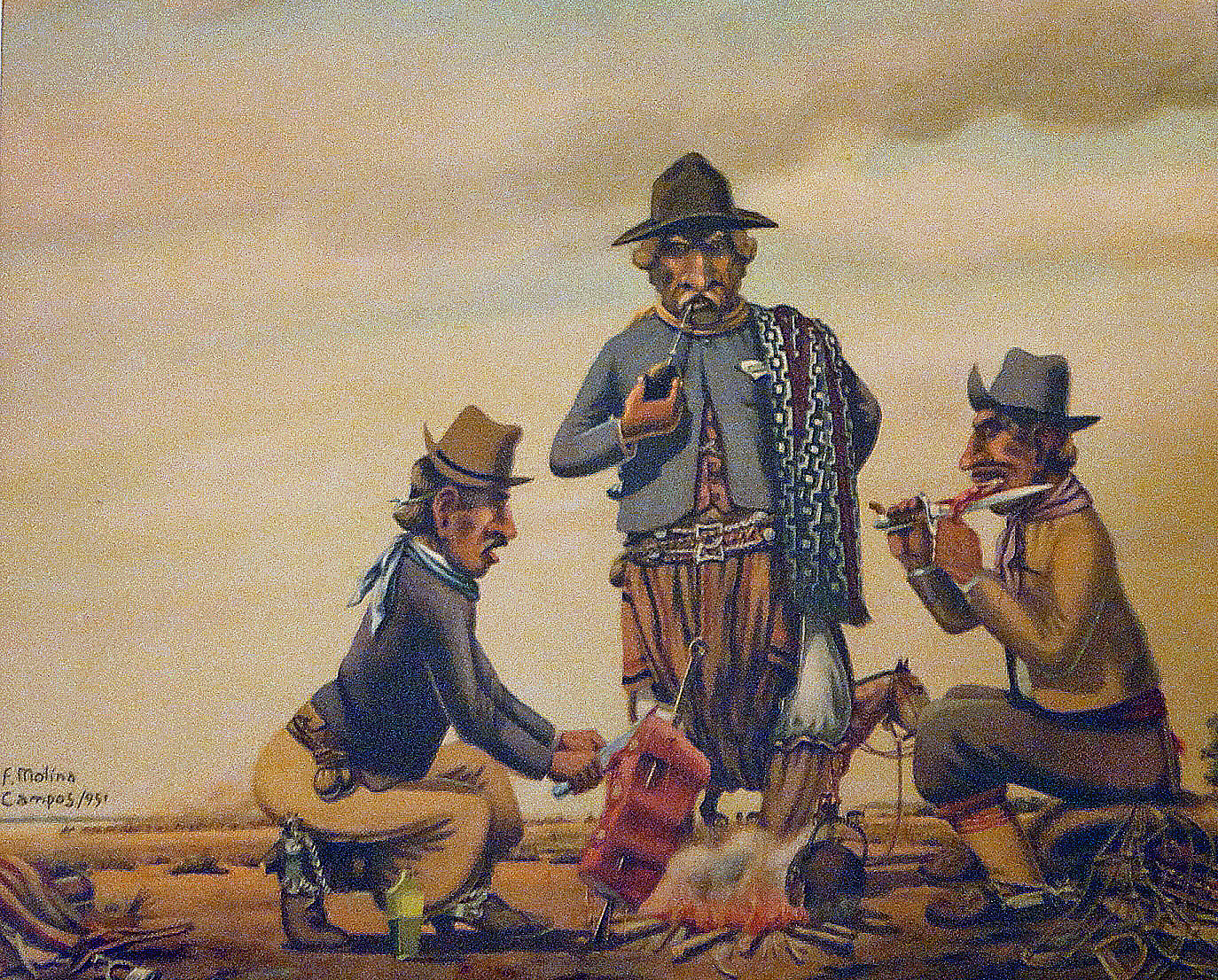
Gauchos barbequeueing their evening meal.  Note the one on the right is holding the meat between his teeth and his left hand, while his right hand holds the knife or facón and slices it away from his hand.  This is the traditional way of eating beef when plates are not available, or simply because they are outdoors.
(Painting by Molina Campos)

-oOo-
Bibliography will be listed at the end of the final post. 
Next post:  The indian raids continue.

Sunday, 2 February 2014

The Story of the Village of Bell Ville, Córdoba, Argentina (Part 2 of 7)

The story so far:
My grandmother and mother were born in Bell Ville, originally named Fraile Muerto, and this series of posts is the result of my research into this village, later a town.  There were English farmers in the countryside and (mainly) Italian immigrants in the town, and I descend from both.
Part 1:  The history of the area up to the mid nineteenth century.


Richard Seymour in later life

The arrival of English pioneers

In January 1865 a young Englishman by the name of Richard Seymour sailed from Liverpool bound for the River Plate to make his fortune.  He and his friend Frank Goodricke purchased land in the south east of the province of Córdoba, in an area near the village of Fraile Muerto.  They were beguiled not only by the low price of land, but also by the sweeping vistas of never ending, well-watered pasturelands with an attractive river flowing through them, imagining it full of contented sheep.  He was told he was close to the indian frontier, but they paid scant attention, judging that the government, so desirous of foreign investment, would protect them.

The railway did not arrive for another few years, and at first Seymour was obliged to travel around the country by diligence, the most uncomfortable form of travel he had ever experienced.  The carriage was pulled by 6-8 horses which were changed every 4 leagues (20km) –

A diligencia in the 1860's

“...A man rides on each of the animals, who pull from the girths and proceed at full gallop without the least regard to ruts, holes, etc ...  roads are not macadamised, being nothing in fact but a track over the prairie.  About 6 unfortunate beings are able to go inside this machine, which looks rather like an aged coach, and two more can sit in front with the driver...

“The accommodations at the post-houses are not very splendid, the beds consisting of our own rugs on the floor; and our dinner... was usually walking happily about when we arrived, and not therefore remarkably tender when it appeared on the table. The country through which we passed was, as usual, perfectly flat, with only a few occasional bushes or a rancho, that is to say, a mud hut, to be seen; a few deer and ostriches sometimes appeared, but the most frequent objects were the large hawks called caranchos, who were generally engaged in picking the bones of some dead animal; they are much hated by the sheep farmer, as they take every opportunity of killing his young lambs, by picking out their eyes...”

He goes on to remark that English knowledge of South American geography was very shaky, for once back in England years later he was often asked by “intelligent people” what it was like to reside in a remote part of the Southern States of America, and how the Civil War had affected him.

Seymour and Goodricke worked very hard to set up their farm, named Monte Molino because it was the name by which the land was known locally.  It was all very basic for a long time because they could not afford to build a proper house.  They shared a rancho – a humble little abode made of mud and straw, along with many dogs who helped with the work, and the farmhands they employed.  There was no fencing or moat to protect them at first, and they were soon to learn the disadvantages of being so exposed.

Traditional romanticised view of a 19th century rancho in Argentina


Nearer to reality 

They staffed their new farm with what they could get – sometimes English or Irish, other times gauchos, the lawless men of European descent who roamed the pampas; or local residents, and wanderers on occasion.   He frequently mentions their capataz (foreman) Gumersindo Lisada, who clearly interested him as a character –

As Gumersindo Lisada might have looked in his Sunday best

“…a handsome, clever man, to whom we at first took a great fancy – was celebrated at Fraile Muerto as being the very worst character in the whole country.  He professed a great regard for us, but cheated us, I believe, on every possible occasion, and did no work he could possibly avoid.  His redeeming point was his courage, and perhaps, in his own peculiar way, he may have had a liking for us… On one occasion he defended his wife and two children successfully in a mud rancho from a sudden attack of Indians, with no better weapon than an old horse-pistol, the unfortunate woman concealing herself behind the door with her baby in her arms, holding her hand on its mouth lest its screams should betray her presence…”

He was starting to find the tales of indian hordes descending on unsuspecting farmers a bit unnerving.  On a trip to a neighbouring village to try to buy sheep, he heard one such tale which clearly made a deep impression on him. 
The late owner of the estancia they were visiting and his capataz had been killed in a fight with Indians just outside his house the year before, when the latter had stood bravely by his master and made an attempt to rescue their cattle from these invaders.  This was the first proper account of indian attacks that they had been told of but they consoled themselves with the thought that they were 60 miles farther from the frontier and therefore not very likely to attract the notice of the marauders. 
They didn’t have long to wait before they were proved wrong.  There were by this time 12 people living at Monte Molino, of which 9 were male adults as there was work going on – at last - digging a ditch round the property and round a further piece of land for the purposes of planting maize. 
Some time after breakfast one morning Lisada, the capataz, was on the roof trying to work out where and how far the horses had wandered looking for good pasture in the night – the roofs of the houses were built flat for the purpose of serving as a lookout post – when he saw some hundred horsemen in the far distance advancing at full gallop.   At first they thought it was just horses, but as Lisada chillingly explained, it was the Indian custom on a raid to cling to the sides of their horses so as to conceal their true numbers.


The men ran the bullock-wagon into the gateway over the ditch, blocking the entrance, and snatched up their guns and pistols.  Seymour gave each of the men a weapon, took up his own gun and revolver, and waited for the attack.  Meanwhile, Lisada’s wife Salomé rushed into the house with her two children and a small trunk, which must have contained all her valuables, and concealed herself in a dark corner where, they afterwards learned, she kept up her spirits during those trying moments by smoking cigarettes.
Ten minutes later the horsemen were within 400 yards of the house and they realised that the actual number of Indians was nearer 50, with the rest being unmounted horses.  They halted, and the mounted men galloped to within 50 yards of the ditch, fanned out and surrounded them on all sides, and again halted.  Seymour instructed everyone in his party not to fire until it was clear that their intentions were hostile.  They stood facing them, waiting until they came closer. 
 “...Lisada now shouted out that if they wished to fight we were quite ready to accommodate them, at which intimation a short parley took place among the Indians, after which 3 of them rode close up to the edge of the ditch, first leaving their long spears stuck in the ground, and one who was evidently a gaucho acting as interpreter, said that the cacique (the chieftain) wished to speak with the owner of the estancia.
I therefore put down my gun and revolver, and walked forward to the edge of the ditch to meet the cacique and his two attendants, having first desired my companions to fire at once if they saw any symptoms of treachery.  The conversation was conducted through the interpreter, as the two Indians could only speak a word or two of Spanish, and was begun by the cacique expressing a wish to come into our house, which polite offer I respectfully but firmly declined.  He then told us he had lost his way, the party having come out on an expedition for hunting ostriches, and had not the least wish to injure us, but was, on the contrary, extremely anxious for our friendship.
While this conversation had been going on, the rest of the Indians had come up close behind the cacique, having also left their spears stuck in the ground; they talked rapidly among themselves, but of course we could not understand a word they said, and only two or three of them appeared to understand any Spanish.  They were small wiry-looking men, with very black hair falling over their shoulders, flat faces with high cheek-bones, and no beard or whisker, and dark coppery complexions....  All were dressed in the Gaucho costume as far as they were dressed at all, some few possessing decent clothes; one, I remember, wore an officer’s coat, having probably murdered the unfortunate owner; but most of them were without hats, and had only a handkerchief tied over their matted locks, and all were excessively dirty.
The cacique, an old man with grey hair, was better got-up than the rest, wearing a large gaily-coloured poncho.  Their arms consisted of spears about 10 ft long, many of them ornamented with bunches of feathers tied round the handles; and bolas, which they carried either round their waists or attached to the pommel of the saddle.
The conversation continued in the same amicable tone, the cacique next mentioning that he was very poor, and would be glad if we would give his men some clothes.  This request I at once complied with, and brought out a few old things, presenting him with an old straw hat of my own, which he at once placed on his head with evident satisfaction.  I also gave them some caña and tobacco, and Lisada and our other peon, seeing the friendly turn affairs had taken, crossed the ditch and handed cigarettes to our visitors, conversing with the interpreter, the only one of the party who dismounted.  Whether this excellent man had been previously known to our equally respectable capataz, I cannot say, but they talked to each other with great apparent interest.  The Gauchos who reside with the Indians have usually committed some atrocious crime which places them beyond the pale even of Gaucho civilisation.
The cacique made repeated declarations that nothing should induce him to injure his new and dear friends, or tempt him to touch their horses, and as we felt very uneasy lest they should fall in with Frank and his companions, whom we were every day expecting with the sheep, we said something about them, when the obliging cacique assured us again that, being friends of ours, they need fear nothing from him.
After staying nearly an hour they all rode slowly off, but before they went we crossed the ditch one by one, and shook hands with the cacique, who was able to say “Adios amigo”.  We were watching the departure of our unexpected and unwelcome visitors with feelings of extreme joy, when to our dismay, we suddenly saw them all draw up on the rising ground about a mile from our house, when half their party rode towards our horses, and in a few minutes they had driven them up to their own troop of unmounted horses, and the whole body were off like the wind, in a northerly direction.  It was impossible to pursue them, as we had only three indifferent horses, on one of which however, Lisada galloped after them for some little distance, shouting like a madman, but I am sure he had not the least intention of overtaking them.”  
Lisada later explained to them that the troop had left them unharmed because they had observed quantity of weapons at their disposal.  A neighbouring farm was not so lucky when they were raided the following day, its owner divested of most of his possessions.  In fact, their neighbour had recognised the straw hat being worn by the cacique and with sorrow concluded wrongly that Seymour himself had perished.
-oOo-
Bibliography will be listed on the final post.
Next time:  Indians and Gauchos

Thursday, 30 January 2014

The Story of the Village of Bell Ville, Córdoba, Argentina (Part 1 of 7)

Introduction


I’ve long wished to tell this story.  Bell Ville is not that different from many villages which grew into towns the length and breadth of the Americas, but I feel strongly that not many of their histories are recorded, and they deserve to be.  I’ve drawn extensively from a book written in the mid nineteenth century by Richard Seymour, an English pioneer farmer who spent only three years in Argentina (1865-8) but managed to pack a wealth of experience into that short time.  He lived between excitement and fear – excitement because he fell in love with the land and its climate; fear because he had not reckoned with the number of native indian incursions and the human, livestock and financial losses constantly sustained as a result. 
The people to whom I refer as indians or natives are the original tribes of Argentina brutally wiped out almost completely in 1878-9, barely ten years after Richard Seymour had returned to England.  Now we perceive them as wronged and cruelly treated, part of the population which was merely trying to survive in a world where being hunter gatherers had become an anachronism and threatened the lives and livelihoods of the rest, the agricultural society and the city dwellers. But at the time they were regarded as pests and standing in the way of progress. They were also unfortunate enough to inhabit some of the most fertile land on the continent.
The constant threat they posed was ignored for decades by a government far more concerned with sending soldiers to their war with Paraguay than in using them to defend the indian frontiers at home.  The pioneer farmers felt abandoned to their fate, and many such as Richard Seymour opted to return to England.


Pink blob marks the location of Bell Ville


Province of Córdoba - Bell Ville is in the centre of the red square.

-oOo-
When it was called Fraile Muerto
During a hot summer in the early 1970’s my mother and I were travelling by car to visit relations in the province of Córdoba, Argentina, when on impulse she suggested we make a small detour to visit the village of Bell Ville, where she was born in 1922 and spent her early years.  Perhaps she could find the house – it had been at least forty years since she had last seen it. 
In the seventies the village was identical to thousands of other rural villages – laid on a grid system with very wide streets lined with plane trees planted in specially dug square holes edged in concrete at equal intervals on the pavement, pruned to within an inch of their lives and trunks painted white up to the six foot mark, looking like survivors of an immemorial flood.  Overhead cables were lazily draped across the streets here and there, sagging in the middle and swaying when there was a breeze.  It was siesta time; the only life to be seen was the occasional dog scratching itself in a shady corner.  There was a very large plaza in the middle of the village, complete with mature trees, criss-crossed at right angles by tiled paths and at the intersection the inevitable equestrian statue positioned in the middle of a dry fountain.  During windy periods dust swirled round the village making doors slam and old windmills clank.
We found the house.  It was now a couturier’s shop, and although the ground floor had been opened up and most of the internal walls removed, the front door and entrance hall were, she said, exactly the same.  It made her misty eyed to remember the design of the old tiles on floor and walls up to waist height, not to mention the heavy wrought iron door with its glass panes. 
I was about eighteen then, and from this distance in time very much regret that I had not yet become interested in photography.  Thus I have no record of that visit.
My mother used to tell us about Bell Ville, a proud little village where Anglo Saxon adventurers had arrived in the mid nineteenth century in search of good land to farm and from which they hoped to become rich by dint of hard work; and later where Italian immigrants had sought refuge from conflict and poverty at the turn of the century.  She was a descendant of both.

Back then, a century before she was born, there were also wanderers from the capital Buenos Aires seeking their fortunes, where failure in one village made them move on to the next; soldiers turned vagabonds and vice versa; and always in the background the original native hunter gatherer peoples (the Ranquel and Tehuelche tribes) who once had had the land to themselves and now regarded the settlers with hostility.  Indeed it was mutual.  No longer able to roam as before, there were easy pickings to be had from the farms, and the tribes regularly staged long distance cattle rustling incursions which included violence to their proprietors and workforces.

Bell Ville’s story is typical of small urban settlements all over the world which grew into towns, weaving struggle and triumph with tragedy, achievement with failure; farmers gambling with the weather and waiting for help from the central government of the day in the form of soldiers to protect them and laws to safeguard their livelihoods.  Lives were spent surviving from one day to the next with no time to record these efforts in any detail, and there are few contemporary accounts.  It is therefore up to us the descendants to piece it all together so that it is not forgotten.

I have tried to assemble what little there is to give readers a flavour of how the area evolved, but have concentrated on Bell Ville as it was, trusting that there is plenty of information in existence about the modern day town.

Argentina had once been under Spanish rule, but achieved its independence in 1816.  The turmoil continued for many decades afterwards, and short-term chancers aside, during this time few foreigners saw it as a good long term investment.  This was to follow later.


The land itself is unchanging.  Nowadays there are sweeping vistas of soya, wheat, sunflower and maize crops.  In the beginning you would have seen gentle undulating pastureland of tufted grass; dark, richly fertile and humid topsoil 50 cm deep at barely 130 metres above sea level crossed by a substantial river, the Río Tercero, part of a system that eventually flows into the Altantic.  In the early days the fauna and flora were rich and varied, the size of the river fish beyond myth - this we know from the memoirs of Richard Seymour - Pioneering in the Pampas (1869).

The picture on the cover is in fact his brother
Walter, who is mentioned later on.
It was natural therefore, that the region should be well frequented going back to the colonial days of the sixteenth century.   It was then part of the viceroyalty of Alto Perú which at its height stretched from Patagonia to Colombia at either end of the Latin American continent.  The area was on the route travellers took while traversing all or part of the 3,200 km distance between Buenos Aires, the large city in the south of the viceroyalty, and Lima, its capital (now the capital of Peru).  The only other choice would have been to navigate up the river Paraná. 

The area was known unofficially as Fraile Muerto – Dead Friar – because according to legend the body of a Catholic friar had once been found amid the carob and hackberry trees, fatally wounded by pumas or jaguars.   Until 1650 it remained as a staging post, when an officer in the Spanish army and his wife purchased a large tract of land there and turned it into an estancia, or large ranch.    They called it “Our Lady of Pure and Clean Conception”, but unsurprisingly it remained Fraile Muerto to most people.

During the 18th century the area had become a fort for defence against Indian raids and later in the following century evolved into a village when the frontier moved a little further away to the surrounding land being purchased and occupied by European pioneer farmers.  The village was located exactly half way between two flourishing cities, Rosario and Córdoba, and thus provided a convenient stopover for travellers. 

For some there was no choice.  In 1807 Mariano and the heavily pregnant Loreta Ascasubi, descendants of freed slaves, were making their way to Buenos Aires in a horse-drawn cart to attend a wedding.  When they reached Fraile Muerto her waters broke, and she gave birth in the back of the vehicle to a little boy, Hilario.  When this child grew up he became one of the best exponents of gaucho literature, as every Argentine primary school pupil knows.

In the environs there were pitched battles not only between the creoles and Ranquel Indians, but also between opposing political factions, the federalists (supporters of provincial autonomous government) and unitarians (who wanted a government centralised in Buenos Aires, the capital).  One of its battles in November 1818 was so local in fact, that it was named El Combate de Fraile Muerto.   The charismatic local leader, federalist Felipe Álvarez was captured and taken as prisoner to the city of Mendoza in the foothills of the Andes, where he was executed.  (Commemorated in the painting below.  Felipe Alvarez is seated, and in uniform) 


By government order his head was returned to Fraile Muerto, where it was put on display on a pike in the public plaza, until pressure from the family persuaded officials to take it down so they could give it a decent burial.  The civil war was to rumble on sporadically for several decades until 1852. 

In the meantime, the village was visited by a delegation from the Vatican in 1824 which was on its way to Chile.  This was a great honour for the devout and God-fearing Catholic community of Fraile Muerto, which at this stage still only numbered some two hundred souls.  Nevertheless they spared no expense to make them welcome and the Delegation was so impressed in fact that as a sign of their gratitude, they promised on their return to Rome to send them a painting of the Virgin for their church.  This did indeed take place, though the process took a long time; the painting of the Immaculate Conception finally arrived 103 years later in 1927, and now adorns a parish church of the same name.  

Iglesia de la Inmaculada Concepción, Bell Ville

It was all the more venerated because one of the senior members of that 1824 Delegation – by name Giovanni Maria Mastai-Ferretti – became Pope Pius IX twenty-two years later.  He served for 32 years, the longest reigning elected pope in the history of the Catholic Church and the first ever to have visited South America.  He died in 1879, and my mother remembered her Italian grandmother – la Nonna – referring to him as il Pio Nono di santa memoria and quoting the oldest locals who remembered his visit as a young man when they were children.

Pius IX (Giovanni Maria Mastai-Ferretti) in dramatic pose

In the 1850s there was at last an effort to deal with the village’s outlandish name, and it was re-christened San Jerónimo.  The governor of the province declared that the old name was “inconvenient”.  It did not however take off, and “Dead Friar” it remained.

The country as a whole was ripe for foreign investment, with vast expanses of very fertile land waiting to be used and few nationals able to afford it.


-oOo-

Bibliography will be listed at the end of the final post.  Anyone wanting credits for their photographs, please let me know. 

Next instalment:  the arrival of the English pioneers and their first encounters with the indians.

Go to Part 2

-oOo-

Wednesday, 13 November 2013

Update


It would have been John’s birthday today, 13th November.  He died almost 8 months ago, but to me it feels like only yesterday.  In that time I’ve gone through various stages – and not necessarily the ones labelled by psychologists.   A blogging friend in Chile said something that made sense, that I can consider myself to be over the worst when I can look back with nostalgia instead of pain.  I’m still wondering how long it will be before I stop feeling that I’ve been cast out to sea towards some unknown and distant shore. 
The legal issues when a person dies are only just being resolved now.  There were things of John’s I wanted to keep, and most of the rest were sent to good homes, but there were plenty I forgot about, and they have appeared around the house to surprise me and make my heart stop from time to time – brandy still in his brandy flask; his little stash of 50 pence pieces for the bridge toll; his favourite ginger jellies languishing at the bottom of a large jar; a box with his witty musical compositions; his metronome. 
Christmas is looming, and I wish I could disappear to a desert island till the new year, instead of avoiding invitations where I can, and sleepwalking through the ones I can’t.  I’m not lonely and have always been fine in my own company – it’s the absence of John himself; the absence of his devotion, nobility, generosity and loyalty that’s the problem.  I know that by shutting myself away I risk being forgotten about, but that will have to take care of itself when the time comes.


Another sadness hit me in August – one of our beloved companions, our 12 year old ginger cat Rusty had to be put to sleep.  Unbeknown to me he used to wander up the road – 10-15 houses away – and he had made friends with an old man who must have reminded him of John, and was there for him during the day when I wasn’t.  This man fed him, and as Rusty was diabetic, I was therefore getting his insulin wrong because I thought his appetite had slowed down.  In any case I was being very careful with the dosage.  Giving him too much insulin had resulted in a terrifying hypo during April when the vet only just managed to save him.  I hadn’t reckoned with this new unknown. 
One night he didn’t come in when I called him... and called him and called him till 1.30 a.m., and eventually gave up.  I wish I had done what John would have done, to walk up the road calling his name.  My neighbours discovered the following day that he had taken refuge in one of the old man’s thorny bushes when his hind quarters inexplicably ceased to function; unable to defend himself blowflies got to him and he was heard crying all night.  I would have heard him if I had not been too nervous to walk up the road in the dark.  I would not have been able to save his life, I know that, but oh I could have shortened his torment, poor little mite. 
Unaware of all this, I was anxious when I left for work the following morning and I asked my neighbours to look out for him.  They called me at work a few hours later when he was found, and we rushed him to the vet.  He explained gently to me that there was nothing further that could be done other than to numb his hind quarters and then put him to sleep.  I stroked him till I felt his life ebb away.
His ashes will go on John’s grave when I put red roses on it today.
Now it’s just his brother Banjo and me, and we’ve got closer than I ever thought a human and a cat could get.  I imagine he’s motivated by anxiety that his remaining meal ticket might get sick and go away too, but I also need him, and we comfort each other.  When I’m obviously sad he sits very close and rests one or both paws on my knee.  I’m so grateful he’s nervous of other people and is not the wandering type, which I think will help protect him from venturing into trouble as Rusty did.
Blogger friends know I love to write, and it’s a good distraction – I’m perfectly aware that this blog has been silent for too long, and I’m struggling to write a post which is turning out much longer than I expected and will probably have several parts.  I’ve no idea if the story of a remote village on the Indian frontier in Argentina in the mid nineteenth century will be of interest, but I hope some will find it so.  I’m sure that readers from the North American continent will find it follows a familiar pattern. 
I’d never make a good writer of history books – I need to be emotionally involved in what I’m telling you.  I want it to shock you as it shocked me, make you laugh and cry as I did.  Overall I suppose I’m trying to say “Argentina is a wonderful place; its heart and soul is not what you read in the newspapers.  Let me tell you about the extraordinary people who made this land.”  (And sometimes about the quirks of my own family).
To finish, I’d like to show you a scan of John’s last birthday card from me in November last year.  I had been nagging him about the idiocy of owning a mobile phone and never leaving it switched on.  Brought up during the war, the “Don’t-waste-the-battery” litany was hard to break.
Don’t give up on me – I’ll be writing about more cheerful subjects soon.  Meantime, don’t forget I’m still working at keeping my other blog going with daily brief entries – Eavesdroppings and Stories – just click on this link.
-oOo-
Related Posts Plugin for WordPress, Blogger...